The Lyceum: Power & Infrastructure Weekly — Aug 01, 2026
Photo: lyceumnews.com
Week of August 1, 2026
The Big Picture
Infrastructure stopped pretending its parts were separate this week. Grid congestion pulled backup generators into regional operations, water scarcity threatened nuclear output, and data-center cooling orders surged. The practical lesson is less dramatic but more useful: the next project delay may come from the pipe, transformer, chiller, permit, or skilled technician sitting on somebody else’s spreadsheet.
This Week's Stories
Washington Turns Backup Generators Into Grid Equipment
Backup generators are meant to be insurance policies: expensive machines everyone hopes will gather dust. For the next few days, they are part of the Southwest Power Pool’s operating plan.
On July 26, the U.S. Department of Energy issued an emergency order allowing the Southwest Power Pool, which serves parts of 17 states, to call on designated generation and backup systems before declaring its highest emergency level. The order remains effective until 11:59 p.m. Central time on August 3. The department estimates that more than 35 gigawatts of backup generation exists nationwide, though that does not mean 35 gigawatts is permitted, fueled, connected, and immediately available. (nytimes.com)
The order lands against a costly backdrop. Reuters reported in July that congestion on overloaded U.S. transmission corridors is raising electricity costs, delaying projects, and preventing available generation from reaching customers. AI-driven demand makes the mismatch impossible to ignore: the American system does not merely need more power plants; it needs wires that can deliver their output.
If backup fleets become routinely dispatchable, microgrid controls, demand-response software, fuel storage, and lower-emission alternatives to diesel become more valuable. Failure looks like a one-off heat emergency with no durable market mechanism to follow. The signal is straightforward: if the Department of Energy extends the order or the Southwest Power Pool develops a repeatable compensation structure, customer equipment has begun becoming grid capacity.
Spain Gives Its Electricity Networks €17.9 Billion of Catch-Up Money
Spain has built renewable generation. Now it must move that electricity to factories, homes, storage projects, heat pumps, and vehicle chargers without turning every connection into a multiyear negotiation.
On July 28, Spain’s Council of Ministers approved a royal decree permitting an additional €17.9 billion of regulated network investment through 2030. Spain’s Ministry for the Ecological Transition says that includes up to €7.7 billion for transmission and €10.2 billion for distribution during 2027–2030; including recurring capital spending, total investment could exceed €35 billion.
Distribution is the crucial half of that sentence. Transmission carries bulk power between regions; distribution handles the less glamorous final miles where electrification actually happens. The decree also strengthens oversight of how regulated investment is used, rather than handing Red Eléctrica and Spain’s distribution operators an unrestricted checkbook.
If the money reaches overloaded substations and connection bottlenecks, Spain can turn renewable capacity into usable electricity and shorten the queue for new demand. Failure would look like nominal spending caps that never become approved projects, equipment orders, or energized connections. Red Eléctrica’s investment plan will reveal whether resilience, renewable integration, or new customers receive priority.
Carrier’s Order Book Says Cooling Is Now Core AI Infrastructure
The chips get the keynote. The chillers, pumps, controls, heat exchangers, and technicians that keep them alive get the purchase orders. (Carrier’s Order Book Says Cooling Is Now Core AI Infrastructure)
Carrier reported on July 28 that second-quarter commercial heating, ventilation, and air-conditioning orders rose roughly 65% from a year earlier, while data-center orders increased more than 300%. Total company orders rose about 40%. Those are Carrier’s figures—not an independent market measurement—and the company did not disclose the cooling technologies, megawatts, customers, or delivery schedules behind the data-center number. (Carrier’s Order Book Says Cooling Is Now Core AI Infrastructure)
The engineering pressure, however, is real. Higher-density computing concentrates more heat into less floor space, forcing electrical and mechanical designs to converge around liquid loops, chilled-water systems, heat rejection, and controls. Cooling capacity is becoming a gating item for computing capacity. (Carrier’s Order Book Says Cooling Is Now Core AI Infrastructure)
If Carrier converts the order surge into revenue without sharply longer lead times, cooling suppliers can scale alongside AI construction. Failure looks like delayed installations, canceled campuses, or orders concentrated among a handful of speculative projects. Carrier’s backlog conversion—and comparable commentary from Trane Technologies and Vertiv—will distinguish a durable infrastructure cycle from an order-book sugar rush. (Carrier’s Order Book Says Cooling Is Now Core AI Infrastructure)
Amazon India Chose Electricity Over Cooling Water
“Waterless” cooling does not eliminate the cooling problem. It shifts more of the burden onto the electrical system.
Amazon said its Indian data centers use air-cooled chillers rather than consuming water for cooling. The company also said its Indian operations are “water positive,” returning 120% of the water used directly, and announced more than ₹620 million—about $7.4 million—for projects expected to replenish over four billion liters annually once completed.
Those are Amazon’s portfolio-level claims. They exclude indirect water use at power plants, construction impacts, and the site-level data needed to compare facilities. Air-cooled chillers avoid evaporative consumption but require more electricity during hot conditions, precisely when air-conditioning demand is already stressing the grid.
If Amazon publishes site-specific electricity and water performance, operators can evaluate whether the trade produces a genuine system benefit. Without those disclosures, “water positive” remains an accounting result rather than a complete infrastructure balance. The numbers to watch are power usage effectiveness—the ratio of total facility electricity to computing electricity—and the water intensity of the electricity serving each site. (Amazon India Chose Electricity Over Cooling Water)
The Danube Is Putting Hungary’s Largest Power Source at Risk
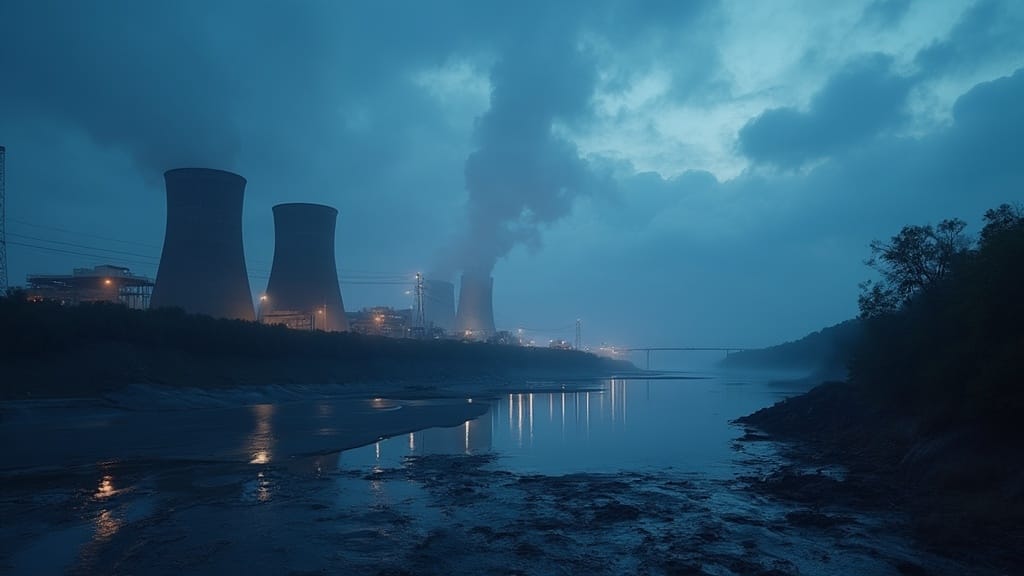
A power station can have fuel, turbines, staff, and transmission access—and still be unable to generate because the river beside it is too low. (The Danube Just Removed Two Gigawatts From Hungary’s Grid)
The Associated Press reported on July 31 that Hungary was preparing to shut all four units at the Paks nuclear plant as record-low Danube levels constrained its cooling-water intake. Paks represents roughly 2,000 megawatts and supplies close to half of Hungary’s electricity. The Associated Press also reported that Romania had shut a reactor at Cernavodă as Danube flows fell to roughly one-third of a typical July level. (The Danube Just Removed Two Gigawatts From Hungary’s Grid)
The timing is brutal: hot weather raises electricity demand while reducing the water available to reject heat from thermal plants. Nuclear, gas, coal, industrial facilities, district-energy networks, and data centers use different cooling designs, but none can ignore where the waste heat goes. (The Danube Just Removed Two Gigawatts From Hungary’s Grid)
If river levels recover quickly, this remains an extreme operating event. If Paks stays unavailable, Hungary will require sustained imports or industrial demand reductions, turning hydrology into a regional power-market constraint. Longer term, the observable response will be investment in alternative intakes, hybrid cooling, thermal storage, or drought-adjusted capacity planning. Without it, “firm” generation will keep carrying a water-level footnote. (The Danube Just Removed Two Gigawatts From Hungary’s Grid)
⚡ What Most People Missed
- MISO’s proposed data-center fast lane: July 30 stakeholder submissions reveal a real fight over studying loads of at least 250 megawatts alongside dedicated generation. Northern Indiana Public Service Company and WEC Energy Group broadly supported a structured pathway, while Sierra Club, the Natural Resources Defense Council, and Fresh Energy argued that the Midcontinent Independent System Operator could create a second interconnection queue that redirects scarce study capacity.
- OpenAI’s Australian cooling redesign: Reuters reported that NEXTDC dropped recycled-wastewater cooling for the planned 612-megawatt S7 campus near Sydney after failing to secure permission for the pipeline. Direct liquid cooling reduces local water dependence but, according to Reuters, raises the project’s electricity requirement—the constraint moved rather than disappeared.
- England’s emerging scarcity tariff: Ofwat closed its consultation on July 30 on rules that would let water utilities reflect long-run scarcity costs and reward efficiency in wholesale charges, potentially from April 2027. If adopted, local water stress could become a visible operating expense for evaporatively cooled data centers and industrial plants rather than a paragraph in a sustainability report.
- Kentucky’s 4.6-gigawatt power plan: Brookfield, NextEra Energy, Big Rivers Electric, Jackson Purchase Energy Cooperative, and Paducah Power System announced a campus plan involving up to two gigawatts of gas generation and 2.6 gigawatts of battery storage. It remains a development proposal, not deployed infrastructure; financing, battery duration, gas supply, and the cooling-water budget are still the documents that matter.
- Entergy’s Meta savings claim: Entergy Louisiana projects that its revised Meta agreement will provide about $2 billion in additional customer savings over 20 years. That is Entergy’s forecast, not delivered savings, and it depends on Meta’s load arriving, construction costs holding, and the contract protecting other customers if the campus changes course—the real test of President Donald Trump’s voluntary ratepayer pledge.
📅 What to Watch
- If the Department of Energy extends the Southwest Power Pool order beyond August 3, it means behind-the-meter generation is becoming an operating resource rather than emergency scenery.
- If MISO approves preferential treatment for generation contracted to large loads, power-purchase agreements could become instruments for obtaining queue priority, not merely buying electricity.
- If Paks remains unavailable for several weeks, drought assumptions will start affecting the capacity value assigned to river-cooled thermal generation across Central Europe.
- If Carrier, Trane Technologies, or Vertiv reports materially longer delivery times, mechanical infrastructure—not chips—will be setting the AI construction schedule.
- If Ofwat adopts scarcity-sensitive wholesale charges, closed-loop cooling and reclaimed-water systems will gain value through operating economics rather than voluntary sustainability targets.
- If the Paducah developers publish a cooling design and annual water budget, “bring your own grid” will have begun expanding into “bring your own utility system.”
The Closer
A diesel generator is sweating through its promotion to power plant. Spain is driving a €17.9 billion check toward the nearest substation. And the Danube is reaching for Hungary’s nuclear off-switch.
Meanwhile, MISO is debating whether a power contract should function like a theme-park wristband for the interconnection queue—which is one way to manage scarcity, if not dignity.
Keep an eye on the pipes.
Forward this to the colleague who still thinks the servers are the complicated part. (The Danube Just Removed Two Gigawatts From Hungary’s Grid)