The Lyceum: Defense Tech Daily — Jul 22, 2026
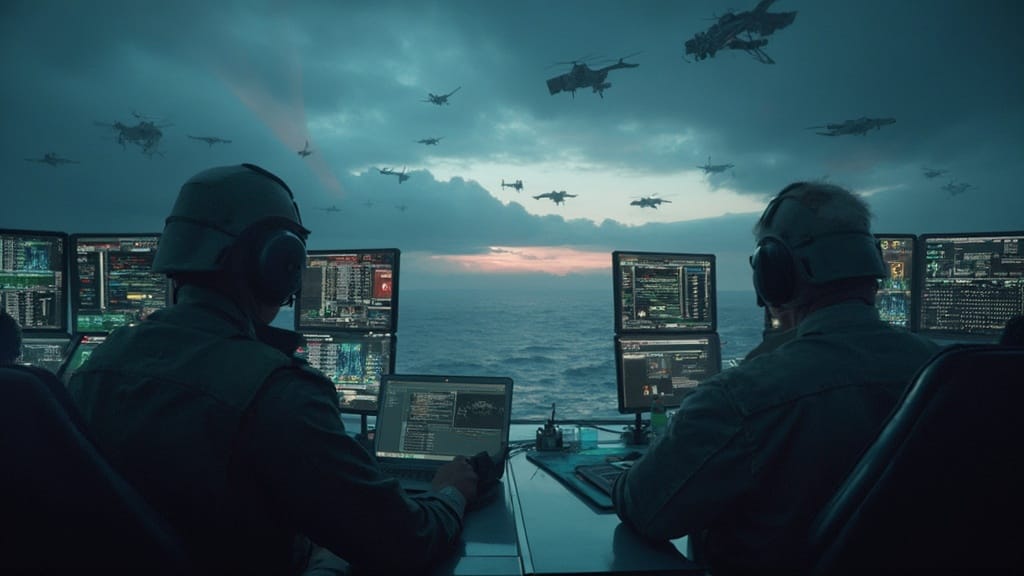
Past 48 Hours — July 22, 2026
The Big Picture
The strongest signal is not a single wonder weapon. It is a shift in military economics: cheaper ways to kill drones, old submarines repurposed as robot motherships, and tighter rules governing artificial intelligence’s access to government data. Meanwhile, the Iran conflict is testing the other side of that equation—whether precision warfare can remain precise, affordable, and politically containable once ships and financial networks become targets.
This Week's Stories
Iran’s pressure campaign is spreading beyond the battlefield
President Donald Trump has promised to “end the war soon.” Iran, meanwhile, is attacking ships, threatening Western banks, and adding to the toll on U.S. forces, according to CBS News. Washington is describing a short war while Tehran is making the conflict harder to confine to military targets.
Iran does not need to sink a fleet to inflict strategic pain. Threats to commercial shipping raise insurance costs and force crews and shipowners to reconsider voyages; threats to banks can make cyber defense part of the war. The battlefield expands without armies advancing an inch.
If the U.S. strategy succeeds, sustained strikes and maritime pressure will push Iran toward negotiations without causing a wider regional crisis. Failure looks like recurring attacks on shipping and finance that outlast the bombing campaign—and the clearest signal will be the creation of a formal multinational escort or surveillance operation around the Strait of Hormuz.
The Marines are putting an AI-powered gun on drone duty
The U.S. Marine Corps is giving drone defense a machine-gun answer. It has selected Allen Control Systems’ Bullfrog robotic weapon system for integration with the Light Marine Air Defense Integrated System, or L-MADIS, according to Breaking Defense. The roughly 300-pound turret uses sensors and artificial-intelligence software to track small drones and can fire about 850 rounds per minute.
The appeal is brutally practical. A defender cannot sustainably answer every inexpensive quadcopter with a missile costing hundreds of thousands—or millions—of dollars. Bullfrog offers a close-range layer built around bullets, reserving scarce interceptors for faster or more dangerous targets.
If the system performs reliably, automated guns could spread from expeditionary bases to ships and allied installations. If its tracking software struggles with clutter, friendly aircraft, or coordinated swarms, human operators will keep tighter control. Follow-on Marine Corps orders and operational deployments will show whether Bullfrog becomes standard equipment or remains an interesting integration test.
⚡ Submarines are becoming underwater robot carriers
The torpedo room may become the Navy’s next robotics bay. A Govly contracting update published July 21 highlights Defense Innovation Unit awards to L3Harris Technologies and HII for torpedo-tube systems that launch and recover unmanned underwater vehicles. The goal is to let existing submarines deploy robots without adding external launchers, modifying their hulls, or relying on divers.
Unmanned vehicles could scout ahead, inspect minefields, gather intelligence, or search for hostile submarines while the crewed vessel remains farther from danger. Just as important, a common launch-and-recovery interface would let the Navy upgrade robotic payloads faster than it can build new submarines.
Recovery is the hard part. Launching a robot through a tube is easier than safely bringing it back to a moving submarine underwater. Successful at-sea demonstrations and production quantities would validate the concept; small experimental orders or repeated recovery delays would suggest the Navy has an elegant architecture that is not yet operationally dependable.
Washington has opened a faster technology lane for the UAE
Washington is using export paperwork to build an alliance faster. The U.S. Commerce Department’s Bureau of Industry and Security changed the Export Administration Regulations on July 10 to give the United Arab Emirates broader access to license-free treatment under the Strategic Trade Authorization pathway. The rule covers eligible Commerce-controlled military items, satellites, spacecraft, and dual-use technologies—civilian products that can also have military applications—and is now in force.
Faster access to eligible sensors, software, satellite components, and other controlled technology can make Emirati systems more compatible with U.S. equipment, especially as attacks around the Strait of Hormuz increase demand for maritime surveillance and air defense.
But streamlined rules do not guarantee actual transfers. If U.S. suppliers and UAE buyers begin using the authorization at scale, the change will deepen technical integration across the Gulf; if approvals remain sparse, the reform will be more diplomatic signal than acquisition engine. The number and type of exports made through the pathway will reveal which outcome is taking shape.
Government data gets a new boundary around large language models
Federal acquisition rules are starting to draw a line around government data and generative AI. The July 21 edition of The Federal Drive with Terry Gerton discussed new federal contract language that applies when government data will be processed by a large language model, with specified exceptions. The available public discussion does not establish the clause’s full reach, so the narrow conclusion is the important one: federal acquisition rules are beginning to treat the combination of official data and generative AI as a distinct risk.
That forces contractors to confront questions ordinary software procurements often avoid. Can a model provider retain prompts? Can government information be used for training? Where is the data processed, and who can inspect the system when something goes wrong? Those details will determine whether commercial AI can enter sensitive workflows quickly or only inside tightly controlled environments.
Broad adoption could create a common safety floor and give compliant AI vendors a clearer market. Overly burdensome or inconsistent enforcement could instead drive agencies toward isolated, expensive systems. Detailed Federal Acquisition Regulation or Defense Federal Acquisition Regulation Supplement language—and the first contract disputes arising from it—will show which direction the government takes.
⚡ What Most People Missed
- DIU’s runway-independent drone race: The Defense Innovation Unit’s submission window for massed modular aircraft remains active, with proposals due July 23. The larger ambition is aircraft designed to coordinate autonomously, operate without conventional runways, and be cheap enough that losing them in combat is expected rather than catastrophic.
- The Pentagon’s new drone boss: DefenseScoop reported that Defense Secretary Pete Hegseth’s July 1 memo consolidated unmanned-systems work under a Direct Reporting Portfolio Manager. The sleeper power is control over interoperability and open-architecture standards: whoever defines the sockets and software interfaces can shape which drones scale across the armed services.
- Containerized autonomous drones: A Defense Innovation Unit effort is moving autonomous drone launch and recovery into shipping-container-sized packages, with Tesseract Ventures among the selected vendors, according to Govly. If the approach works, military units could add drone capacity without constructing permanent airfields or bespoke launch infrastructure.
- Pentagon anti-vaccine blowback: Reuters reported in 2024 that the Pentagon ran a covert campaign to undermine confidence in Chinese COVID-19 vaccines, particularly in the Philippines. That history now shadows military adoption of AI-assisted influence tools: software may make messages cheaper to generate, but it cannot make institutional credibility cheaper to replace.
📅 What to Watch
- If the Marine Corps places follow-on Bullfrog orders beyond initial integration, it means gun-based drone defense is becoming a procurement category rather than a demonstration.
- If L3Harris Technologies or HII demonstrates routine torpedo-tube recovery at sea, it means existing submarines can gain new missions through payload upgrades instead of multibillion-dollar hull programs.
- If federal agencies publish detailed restrictions on model training, prompt retention, and data location, it means AI procurement will increasingly be decided by data custody—not benchmark performance.
- If U.S. suppliers begin using the United Arab Emirates’ new export pathway for space and sensing components, it means export-control policy is becoming an operational layer of Gulf defense architecture.
- If attacks on commercial shipping produce a standing multinational escort network, it means Iran has forced governments to turn temporary crisis management into permanent maritime infrastructure.
The Closer
A machine gun is learning to swat quadcopters. A submarine is trying to inhale its robot through a torpedo tube. Federal lawyers are erecting a velvet rope around the chatbot.
The future of war apparently runs on open architecture—except when the architecture contains government prompts, vaccine memes, or a recovery vehicle that refuses to come home.
Keep your sensors clean.
Forward this to the person who still thinks the drone problem is mostly about flying.