The Lyceum: Defense Tech Daily — Jul 18, 2026
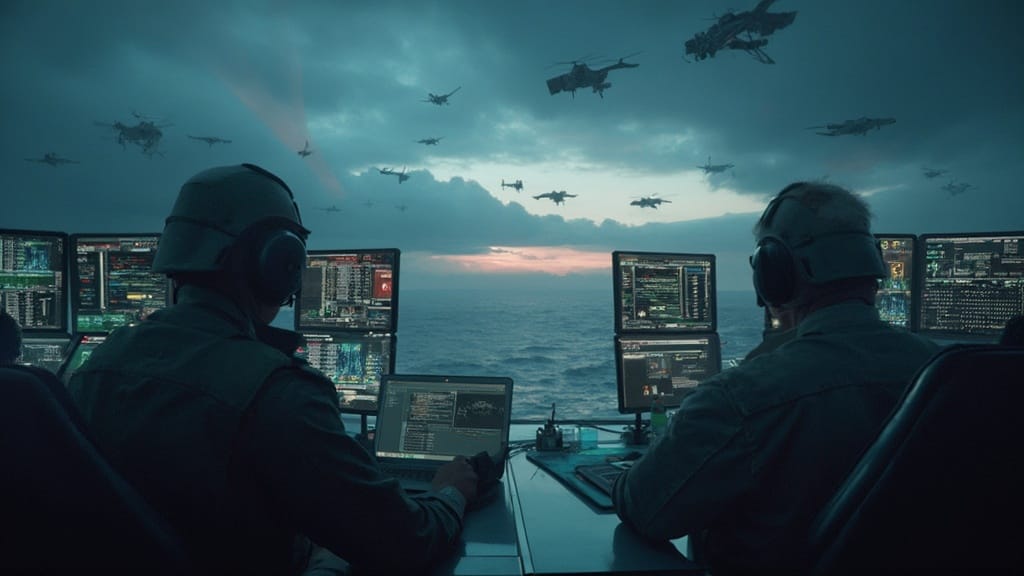
Photo: lyceumnews.com
Past 48 Hours — July 18, 2026
The Big Picture
The U.S.–Iran war is grinding through its second ceasefire collapse in three months, and it's dragging the price of your gas past $4 a gallon. But underneath the headlines, something quieter and bigger is happening: the world's militaries are all reorganizing around the same idea at once — cheap, disposable, networked machines. Sea drones damaged an Iranian naval base for the first time in history. Britain named a whole family of robot warplanes. NATO put $40 billion behind killing drones. The lesson from Ukraine has officially escaped the classroom.
This Week's Stories
Sea Drones Went to War — and Hit an Iranian Naval Base
The U.S. military just sent robotic boats to attack another country's naval infrastructure — and posted the video.
According to Defense News, U.S. Central Command used three Corsair unmanned surface vessels to damage a submarine and ship-maintenance facility at Iran's Bandar Abbas naval base — the first time American forces have used sea drones in combat. Breaking Defense and Defense Daily corroborated the strike, with CENTCOM's own footage showing the crewless boats motoring toward docks and detonating. The Corsair is built by US-based Saronic Technologies, and each one costs a fraction of a conventional strike weapon.
Here's why it matters beyond the fireworks: every navy on earth was watching for exactly this moment. A crewless boat packed with explosives that drives itself to a target rewrites the math of naval warfare — you no longer need a billion-dollar hull to threaten one. If Corsairs reappear the next time Iran hits a tanker, that's your signal this has crossed from experiment into standing doctrine, and the naval arms race reorients around $150,000 boats. If they don't, it stays a one-off demonstration. Watch the next exchange.
Britain Just Named Its Drone Air Force — All Three of Them
Most countries announce one drone program at a time. Britain announced three in a single speech.
The RAF designated its drone-wingman effort "Storm Fighter," a name disclosed by Luke Pollard, the UK's former minister of state for defense readiness and industry, who told the Global Air and Space Chiefs Conference the drones would act as both "guardian angel" and "attack dog" for crewed jets. But the family is what matters. Storm Chrome is built for electronic attack — jamming and blinding enemy radar. Storm Fire is a one-way attack drone that can reach targets up to 1,000 miles away. Per Aviation Week, Storm Fire is an "ultralow cost, long-range" drone built through "federated manufacturing" — spread across many small sites so production can scale fast in a war — and likely a rebrand of Lanner, a foam-molded design meant to cost under £20,000 a copy. (Low-Cost RAF Attack Drone Made For Mass Production In Conflict | Aviation Week)
Think of it as a tiered robot air force: cheap suicide drones at the bottom, jammers in the middle, full wingmen at the top. If it works, Britain gets cruise-missile reach at a hundredth of the price. What tells you it's stalling: Storm Fighter is still a name attached to a requirement — no design, no contractor, no timeline. The UK has pledged £300 million ($405 million) and a demonstrator by "at least 2030." Watch which firm — BAE Systems or Boeing, both reportedly circling — actually wins the work.
The Marines Just Plugged a 30-Year Gap in Pacific Air Defense
If China ever tests U.S. resolve in the Pacific, Guam is the first island it would need to neutralize. Until recently, the Marines defending it had a real problem. (The Marines Just Plugged a 30-Year Gap in Pacific Air Defense)
Marines on Guam live-fired the Corps' new Medium-Range Intercept Capability — its first medium-range air defense system since it retired the legacy HAWK in the 1990s. For three decades, Marines relied on shoulder-fired Stinger missiles for close threats and borrowed the Army's Patriot batteries for anything bigger. The MRIC stitches together existing parts: a G/ATOR radar that spots incoming threats, a CAC2S command system that crunches the data, and Iron Dome–derived launchers that do the intercepting. It slots neatly between the Stinger and the Patriot. (The Marines Just Plugged a 30-Year Gap in Pacific Air Defense)
The point is independence. Marines now have layered air defense that travels with them, rather than depending on Army assets that might not be on a given dispersed island. It plugs into a larger Guam Defense System — distributed radars, hardened launchers, underground bunkers — designed to absorb a Chinese missile-and-drone barrage. The Corps plans to field MRIC across all three Low Altitude Air Defense Battalions between 2026 and 2028. If those deliveries slip, the gap stays open where it matters most. (The Marines Just Plugged a 30-Year Gap in Pacific Air Defense)
The Pentagon Quietly Suspended a Major Cybersecurity Mandate — Mid-War
While missiles fly over the Gulf, the Pentagon hit pause on one of its biggest efforts to secure the companies that build American weapons. (U.S. Marines Deploy New SkyHunter-Based MRIC Air Defense System on Guam During V)
Breaking Defense reported that senior officials announced the immediate suspension of CMMC Phase II — the second stage of the Cybersecurity Maturity Model Certification program — calling it too burdensome for the defense industrial base. A Department of War notice confirmed the requirements are halted for at least 60 days pending a "reform" review, and Defense One reported the paused stage was precisely the one that would have required outside auditors instead of companies grading their own homework. Phase I stays in place. (U.S. Marines Deploy New SkyHunter-Based MRIC Air Defense System on Guam During V)
The tradeoff is blunt: leadership is choosing production speed over compliance strictness at the exact moment nation-state hackers are probing the same supply chains. That might keep factories humming; it also feeds more leaky networks into frontline systems. Watch whether Congress or CISA reacts with hearings or legislation. If they do, this "pause" becomes a real fight over how much security the U.S. will trade for wartime output. (U.S. Marines Deploy New SkyHunter-Based MRIC Air Defense System on Guam During V)
The Ceasefire Is Dead Again — and This Time the Machines Are Fighting
The June deal to end the U.S.–Iran war lasted less than a month, and the reason it collapsed tells you it was never built to last.
Trump notified Congress that "limited" military action has resumed; Tehran launched strikes on U.S. regional allies and claimed it disabled two supertankers in the Strait of Hormuz, sending oil prices up more than 9% on the session. Per CBS News, Trump has floated wrapping the war up "in two to three weeks" even as gas crosses $4 a gallon, and told Iran to reopen the Strait or be "blast[ed]," according to The Times. But the structural problem is what Carl Schuster, former director of U.S. Pacific Command's Joint Intelligence Center, told CNN: the ceasefire "had little chance of survival because the Iranian government that signed it has no authority over the Islamic Revolutionary Guard Corps" — the force that controls Iran's missiles and answers only to the Supreme Leader.
CENTCOM says it's damaged Iranian air defenses, command networks, coastal radar, anti-ship missiles, and more than 60 IRGC small boats. The conflict is bleeding outward — DW reported an Iranian missile headed toward Turkey was destroyed midair, and the New York Times reported Trump wants to delay his China visit because of the war, a reminder that a Gulf chokepoint can freeze a superpower summit. Watch whether a mediator — Pakistan and Qatar have both been in the room — can get anyone back to the table before the strikes escalate.
⚡ What Most People Missed
The Space Force restarted its missile-tracking satellite mesh: After a nine-month pause, the Space Development Agency lofted 21 Transport Layer satellites on a SpaceX Falcon 9 from Vandenberg on July 16, bringing it past 60 of a planned 126-satellite network that shuttles targeting and missile-warning data between sensors and shooters. The rockets clearly work — the open question is whether the laser cross-links between satellites do. That's the actual bottleneck for "Golden Dome," and no launch count answers it.
NATO put $40 billion behind killing drones: Reuters reported that NATO foreign and defense ministers approved a five-year, $40-billion-plus program to buy drones, build counter-drone defenses, and train operators, unveiled in Ankara on July 17. It effectively makes cheap-drone warfare an alliance-wide industrial problem rather than a U.S. side project. Separately, the U.S. Army handed Anduril a $20 billion counter-drone contract and then picked its Lattice software as the first task order — a signal that startups, not just legacy primes, now win the biggest counter-drone money.
Germany is funding 50,000 strike drones for Ukraine: Defence24 reported the number, and it's not a typo. For scale, the entire U.S. Tomahawk cruise-missile inventory is estimated in the low thousands. This is what it looks like when a major economy decides to treat drones like ammunition — and it quietly makes Germany one of the war's most consequential arms suppliers.
The Pentagon wants autonomous jamming boats: The Defense Innovation Unit opened a solicitation for crewless surface vessels that can sense the radio environment and jam enemy signals in real time without a human steering them, with submissions due July 22. It's not another "AI for paperwork" pitch — it's a request for autonomous electronic warfare at sea, and DIU tends to ask industry for hardware before the concept becomes a trade-press theme.
Japan flung open its arms-export doors: A July 14 Congressional Research Service report, surfaced by USNI News, laid out how Prime Minister Sanae Takaichi lifted Japan's ban on lethal-weapons exports in April 2026, clearing sales to 17 partner nations including the U.S., Australia, India, and the Philippines. Australia has already contracted for 11 Japanese-designed warships. Tokyo just went from defense customer to defense supplier. [Source: Eurasia Review / Japan Times — English translation of Japanese policy]
📅 What to Watch
- If Corsair sea drones reappear the next time Iran hits a tanker, kamikaze drone boats have crossed from demo to doctrine — and every navy reorients its budget around cheap hulls, not expensive ones.
- If a new Iran deal ships without a Hormuz governance mechanism, the next ceasefire is just a countdown to the next blockade, not a path to peace.
- If the SDA's next launch flies clean but the laser cross-links still can't be demonstrated, the Golden Dome bottleneck is confirmed to be networking, not rockets — a far harder problem to buy your way out of.
- If Congress or CISA formally challenges the CMMC suspension, it forces a public reckoning over how much cybersecurity the U.S. will trade for wartime production speed.
- If any NATO member folds Ukrainian drone doctrine into its official field manuals, the "smaller force punches above its weight with autonomy" lesson stops being admiration and becomes policy.
The Closer
A crewless speedboat filming its own suicide run into an Iranian pier; a foam-molded British drone that costs less than a used Mercedes and flies a thousand miles to die; and the Pentagon quietly loosening its cyber rules while the hackers are literally in the room. The through-line of the week is that everyone's cheapest weapon just became their most important one — which is a strange time to be building 21 satellites you can't yet talk to each other. Stay suspicious of the round numbers. (Ceasefire with Iran hangs in the balance. Can the US ever deliver a knockout blo)
Forward this to the friend who still thinks wars are won by the side with the biggest ships.
⚡ EDGE Signals
The following signals appeared in the adversarial edge sweep but were not carried forward in the primary synthesis:
- DefenseScoop's July 15 interview with DIU director Owen West is just outside the strict 48-hour window, but its implications sharpened this week because it lines up with the July 17 DIU solicitations and the July 1 autonomy-reorganization memo now shaping execution. West said DIU is collapsing seven
- A quick front-page sanity check: the big Iran war developments, the Strait of Hormuz threats, the reported missile incident involving Turkey, and the China-trip delay all sit in the background of this issue rather than as standalone "early signals" because they are already dominant headline news, no
- [15] SpaceX Wins $4.16 Bn Contract for Military Satellites | SpaceX To Build 'Eyes in the Sky' | WION
URL: https://www.youtube.com/watch?v=vREb_hb8ku4
Snippet: Officials say the first operational satellite
{ts:32} constellation is expected to be deployed by 2028, helping close critical surve
- [23] President Trump indicated Tuesday the Iran war may wrap up "very ...
URL: https://www.facebook.com/CBSBaltimore/posts/president-trump-indicated-tuesday-the-iran-war-may-wrap-up-very-soon-and-he-coul/1357741969720827/
Snippet: President Trump indicated Tuesday the Iran war may wrap up "v
- [28] Trump tells Iran 'open the F—in' Strait, you crazy b——ds,' — as he warns of new strikes and says 'praise be to Allah'
URL:
Snippet: President Trump kicked off Easter Sunday with a foul-mouthed tirade against Iran and praising Allah — warning the regime to 'open the f—in'' Strait of Hor