The Lyceum: Defense Tech Daily — Aug 11, 2026

Photo: lyceumnews.com
Past 48 Hours — August 11, 2026
The Big Picture
No single technological rupture defined the past two days. Instead, the same pressure surfaced at every altitude: attackers are buying range and volume, while defenders scramble for cheaper ammunition, deeper magazines and communications that still work after the network buckles.
One timing note: the August 1 barrage over Kyiv, the August 6 Houthi attacks in Yemen, the earlier interception of an Iranian missile near Turkey and the Pentagon press-policy dispute remain important context, but none produced a qualifying new event between August 9 and August 11.
This Week's Stories
Ukraine’s Drones Brought the Oil War Deeper Into Russia
Ukraine took the oil war deeper into Russia on Monday, attacking the Nizhnekamsk petroleum hub in Russia’s Tatarstan region. Local authorities said 13 people were killed and 78 injured, making it one of the deadliest Ukrainian attacks inside Russia since the full-scale invasion began, the Associated Press reported.
The strategic lesson is uncomfortable and increasingly familiar: a country does not need conventional bombers if it can manufacture enough expendable aircraft with sufficient range. Ukraine cannot match the Russian Aerospace Forces plane for plane, but its long-range drones can still force Russia to defend refineries, factories and storage sites far from the front.
If this campaign succeeds, Russia must spread finite air-defense systems across an enormous industrial map. Failure looks like expensive raids that cause civilian casualties without materially disrupting production. The clearest signal will be whether Russia moves additional defenses toward energy facilities or simply absorbs the damage.
The Army Wants Flak Guns Back for the Drone Age
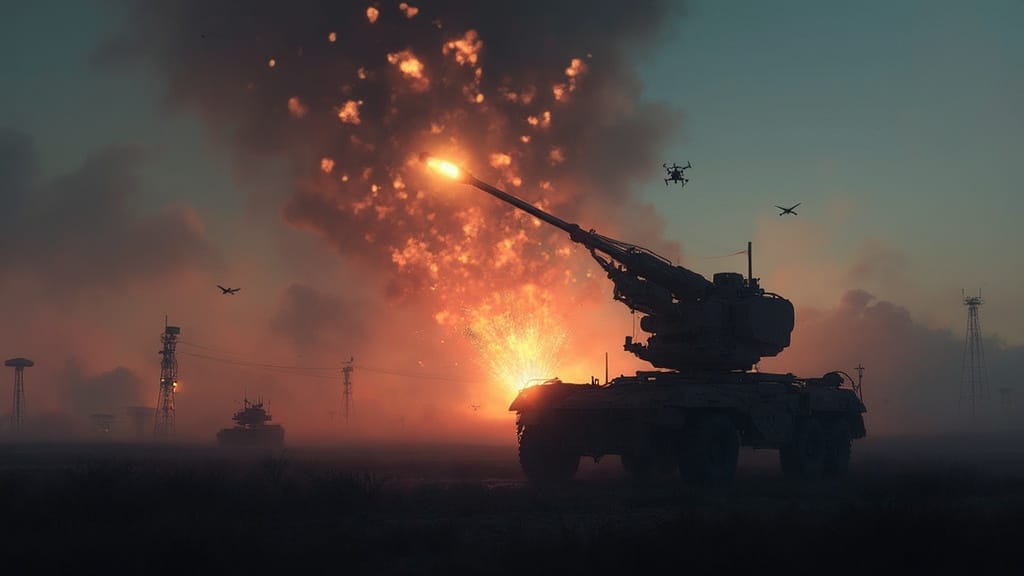
The U.S. Army is looking to make drone defense cheaper and deeper. It issued an industry notice Monday seeking ammunition and system concepts for Northrop Grumman’s XM913 50-millimeter chain gun, Defense News reported. A planned demonstration would pit the weapon against targets ranging from small quadcopters to aircraft weighing as much as 1,320 pounds.
The appeal is economic. Programmable airburst shells explode beside a drone and throw fragments across its path, avoiding the need for a perfect direct hit. At up to 200 rounds per minute, the XM913 could provide a much deeper defensive magazine than launchers stocked with costly missiles.
If the cannon reliably defeats maneuvering drone groups, military bases gain a cheaper middle layer between electronic jammers and interceptors. If it requires lavish sensor support or burns ammunition against decoys, the economics unravel. Company responses remain due August 31, and ammunition cost plus multi-target performance will tell the story. (The Army Wants to Bring Flak Guns Back for the Drone Age)
DARPA Wants a Hypersonic Missile Built Like a Production Car
DARPA wants to build hypersonic weapons for the factory floor, not just the test range. The Defense Advanced Research Projects Agency has requested concepts for a Next Generation Hypersonic Cruise Missile, Defense News reported. DARPA wants an air-breathing weapon—powered by a scramjet engine—that can exceed Mach 5, maneuver around defenses and eventually be manufactured in useful numbers. (DARPA Wants a Hypersonic Missile That Can Dodge Defenses—and Be Built in Numbers)
That last requirement matters most. Hypersonic programs have traditionally pursued extreme performance first and worried about factory throughput later. DARPA is asking whether survivability, rapid testing and affordability can be designed into the same weapon from the beginning. (DARPA Wants a Hypersonic Missile That Can Dodge Defenses—and Be Built in Numbers)
Success would give U.S. fighters, bombers, ships and ground forces a mass-producible way to strike through sophisticated air defenses. Failure looks like another exquisite prototype stalled by heat, propulsion or manufacturing problems. Responses are due October 6, and the first meaningful signal will be whether proposals offer rapid flight tests rather than another decade-long development schedule. (DARPA Wants a Hypersonic Missile That Can Dodge Defenses—and Be Built in Numbers)
Taiwan Practiced Fighting With Bad Internet

Taiwan deliberately throttled mobile data across seven central cities and counties for 30 minutes Monday during civil-defense exercises accompanying its Han Kuang war games, Reuters reported. Voice calls and text messages remained available, while ordinary 4G and 5G data became difficult to use.
It was a modest-sounding test of an enormous wartime vulnerability. A Chinese attack could damage cables and cellular infrastructure, while cyberattacks, electronic warfare and millions of frightened users could overwhelm whatever remains.
If Taiwan learns which backup channels people actually use, degraded connectivity can become a measurable readiness requirement rather than a civil-defense slogan. Failure is a theatrical slowdown that produces no operational data. Northern Taiwan, including Taipei, is still scheduled for a similar drill on August 13. (Taiwan Practiced Fighting With Bad Internet)
The Next Korea War Game Will Break the GPS on Purpose
The next U.S.-South Korean war game will deliberately break the tools forces depend on. South Korea and the United States have set Ulchi Freedom Shield for August 17–27, with roughly 18,000 South Korean troops expected to participate alongside U.S. forces, the Associated Press reported. The exercise plan includes drone threats, cyberattacks and GPS jamming—the deliberate disruption of satellite-navigation signals. (news.immigration.gov.tw)
The design reflects a battlefield where systems fail together. North Korea has flown drones across the border, built substantial cyber capabilities and repeatedly interfered with GPS reception near South Korea, according to the Associated Press.
If units must operate through sustained, unscripted disruption, the exercise could force practical changes in navigation, communications and command procedures. If the outages arrive on schedule and disappear before they become inconvenient, little changes. The test is whether commanders are allowed to fail—and adapt—while the network stays broken.
Russia’s Faster Attack Drones Could Break Ukraine’s Cheap Defense
Russia is trying to make Ukraine’s cheapest answer obsolete. Vadym Skibitsky, deputy chief of Ukraine’s Defense Intelligence Directorate, told RBC-Ukraine that Russia planned to manufacture 11,000 strike drones in August and was shifting part of its production toward turbojet-powered Geran-4 and Geran-5 models. Skibitsky said faster models represented half of one recent attack and currently use Chinese engines costing roughly $35,000–$40,000 each. (RBC-Ukraine)
Those figures are a Ukrainian intelligence assessment, not Russian-confirmed production data. But the reported direction makes sense: Ukraine has developed inexpensive interceptor drones against slower, propeller-driven Geran-2s, giving Russia an incentive to make the target faster rather than merely more numerous. (Russia’s Arena tank defense reportedly stopped seven FPV drones)
If jet-powered models begin appearing routinely, Ukraine may need costlier sensors and interceptors, restoring the unfavorable economics it had started to escape. If production remains limited or reliability suffers, the shift is more adaptation experiment than revolution. The observable signal is the share of jet-powered drones in successive barrages.
Russia’s Arena Tank Defense Worked—Until Its Magazine Was Empty
Russia’s Arena tank defense worked—until it ran out. Combat-drone specialist Dmytro Putiata said a Ukrainian unit reported that the Arena active-protection system on a Russian T-72B3A damaged seven first-person-view drones. According to the account relayed through Putiata, the unit required 15–20 drones to destroy the tank after Arena exhausted its countermeasures. (Russia’s Arena tank defense reportedly stopped seven FPV drones)
This is a credible battlefield signal, not a verified after-action report. The seven-drone count rests on one unit’s account, although Defence Blog reported that available footage appeared consistent with depleted countermeasures.
If Arena repeatedly imposes that exchange rate, protected tanks become much harder and costlier to kill. Failure is simpler: attackers learn the magazine depth and overwhelm it deliberately. Watch whether Russian vehicles receive additional countermeasures—or whether physical constraints around the engine-access hatch make that impractical. (Russia’s Arena tank defense reportedly stopped seven FPV drones)
A British Drone Boat Was Only as Sovereign as Its Camera
A British drone boat’s sovereignty proved only as strong as its camera. A United Kingdom Ministry of Defence cyber assessment identified a subsystem issue involving cameras aboard Royal Navy Kraken K3 Scout uncrewed boats, Defence Blog reported. The ministry disconnected the affected cameras and said it found no evidence that ministry data or systems had been accessed or transmitted externally. (Royal Navy drone-boat cameras were communicating with China)
The £12 million Kraken K3 fleet entered Royal Marines service in March. The boats were built in Britain, but their Night Navigator cameras came from Canada’s Current Scientific Corporation; reporting that the cameras sent automated “heartbeat” communications to an internet address in China originated with The Telegraph. (Royal Navy drone-boat cameras were communicating with China)
If the remediation holds, this becomes a useful warning about auditing the hidden components inside military robots. If similar connections appear elsewhere, governments will have to treat cameras and processing modules as strategic supply-chain risks. Procurement rules requiring component-level network testing would be the clearest sign that the lesson stuck.
Yemen’s Rear-Area Bases Are Rear Areas No Longer
Rear-area bases in Yemen are rear areas no longer. No qualifying new Houthi attack was reported between August 9 and August 11, but the August 6–8 escalation remains the regional baseline defense planners are working from. Reuters reported that the Iran-aligned Houthis launched ballistic missiles and drones at displacement camps and residential areas in Marib on August 7, killing two people and injuring 14.
Separately, The New York Times and The Washington Post reported that earlier Houthi attacks damaged government positions in Marib and Hadramout, killing at least 30 troops. Those attacks showed how missiles and drones can turn camps far behind an apparent front line into precision targets.
If the pattern resumes, Saudi Arabia, the United Arab Emirates and Yemen’s internationally recognized government may have to divert sensors and interceptors from oil infrastructure and cities toward dispersed military sites. If the attacks remain episodic, expensive new defenses may be difficult to justify. Renewed salvos—or permanent counter-drone deployments around camps—will reveal which calculation wins.
⚡ What Most People Missed
- The FCC is moving down the drone supply chain: An FCC public notice proposes adding certain foreign-made drones with LiDAR—laser sensors that measure distance—to its national-security Covered List. The consequential idea is not one consumer model disappearing; it is Washington beginning to regulate autonomy-enabling sensors as strategic components.
- The Marine Corps wants microwave weapons on interchangeable mounts: Breaking Defense reported that Epirus received an $11 million contract for its HAVOC counter-drone system and a universal sled mount. If the mount works across crewed and uncrewed vehicles, the weapon becomes movable infrastructure rather than a permanent appendage to one platform.
- The Air Force wants AI in the Minuteman III filing cabinet: Breaking Defense reported that a new tool would organize information spread across roughly 60 data sources used to sustain the United States’ aging Minuteman III intercontinental ballistic missiles. Maintenance software is less cinematic than autonomous weapons—and may produce operational value much sooner.
- The Navy’s robot boat joined routine weapons training: Defense News reported that the Global Autonomous Reconnaissance Craft entered its first live-fire exercise. One demonstration proves a machine can shoot; recurring training would show sailors are starting to treat it as fleet equipment.
📅 What to Watch
- If Russia permanently moves air-defense systems toward refineries and factories, Ukraine’s drone campaign will be weakening protection elsewhere even when industrial damage is limited.
- If the Army publishes affordable per-kill figures for the XM913, drone defense could shift from missile scarcity toward ammunition logistics.
- If Taiwan’s August 13 drill identifies backup networks that civilians actually use, communications degradation may start shaping infrastructure spending as well as military planning.
- If jet-powered Geran drones become a regular share of Russian barrages, Ukraine’s cheap interceptor-drone advantage will have triggered an expensive counter-adaptation.
- If Ulchi Freedom Shield keeps units disconnected longer than commanders find comfortable, cyber and electronic warfare will finally be treated as operating conditions rather than scripted injects.
- If Britain mandates outbound-connection testing for every subsystem aboard military robots, one chatty camera will have rewritten procurement policy.
The Closer
A 50-millimeter cannon is relearning flak, Taiwan is putting seven regions on dial-up, and a Russian tank is counting incoming drones like a bartender counting bad decisions.
The future of sovereign warfare, naturally, may depend on whether the camera remembers to phone home.
Keep your magazines deep.
Forward this to someone who still thinks the internet is guaranteed.
⚡ EDGE Signals
The following signals appeared in the adversarial edge sweep but were not carried forward in the primary synthesis:
- Vadym Skibitsky, deputy chief of Ukraine’s Defense Intelligence Directorate, told RBC-Ukraine on August 10 that Russia plans to manufacture 11,000 strike drones in August and is retooling production toward the turbojet-powered Geran-4 and Geran-5. Skibitsky said those faster models made up half of o
- The Telegraph reported on August 10 that cameras aboard the Royal Navy’s Kraken K3 Scout uncrewed boats were sending automated “heartbeat” communications to an internet address in China. Britain’s Ministry of Defence confirmed that a routine cyber assessment found a subsystem issue, disconnected the