The Lyceum: Defense Tech Daily — Aug 01, 2026
Photo: lyceumnews.com
Past 48 Hours — August 1, 2026
The Big Picture
The past two days brought fewer dramatic unveilings than consequential commitments. Iran is forcing the United States to expend scarce interceptors in the Gulf, while Washington is financing domestic drone factories, mobile jamming trucks and shipboard disease detection—the less glamorous infrastructure of a conflict expected to last.
What Just Shipped
- SkyValor (CACI International): Joint Interagency Task Force 401 awarded CACI an up-to-$500 million contract, announced July 30, with an initial task order to integrate the counter-drone system onto heavy trucks.
- Domestic Drone Component Manufacturing Program (Performance Drone Works): The Office of Strategic Capital signed an up-to-$820 million conditional loan commitment on July 31 to expand U.S. production of components for small military drones.
- DeepSeek-V4-Flash (DeepSeek): DeepSeek released the tool-using AI model into public beta on July 31, with capabilities aimed at extended computer tasks, software-tool use and coding.
This Week's Stories
Iran Is Making America Defend the Gulf One Expensive Interceptor at a Time
Iranian state media said Iran attacked a U.S. air base in Kuwait with drones on Friday. The Associated Press reported that significant damage had not been independently confirmed. The White House accused Tehran of violating an earlier truce, attacking commercial ships and killing American personnel.
Whether individual drones reached their targets is the immediate question. The larger problem is arithmetic. Iran can combine relatively inexpensive one-way attack drones with faster ballistic missiles, forcing American and allied defenses to identify several threat types and decide which merit scarce Patriot interceptors.
If that pressure continues, Iran does not need to penetrate every defense. It only needs to force the United States to move Patriot batteries or missile-equipped ships from other theaters—including Europe—or accept greater risk around Gulf bases and shipping.
From Iran’s perspective, failure would mean barrages landing without operational effect while American interceptor stocks and regional deployments remain stable. Watch for additional Patriot batteries moving into Kuwait. That would show the campaign is already rearranging defenses far beyond the Gulf.
The Pentagon Is Putting Counter-Drone Jammers on Trucks
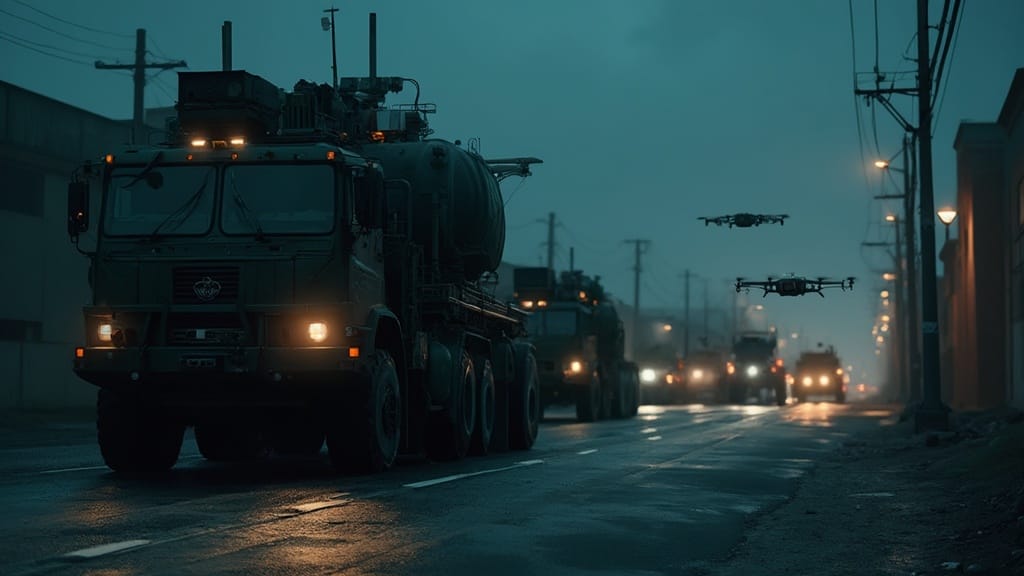
The Pentagon is taking counter-drone jamming on the road. Joint Interagency Task Force 401 awarded CACI International an indefinite-delivery, indefinite-quantity contract with a ceiling of $500 million for its SkyValor counter-drone system, DefenseScoop reported. That contract type authorizes orders up to the ceiling; it does not guarantee that the Pentagon will spend the full amount. (Pentagon’s $500 Million Mobile Counter‑Drone “Domestic Shield” Comes Into Focus)
The first task order will integrate SkyValor onto heavy trucks. The system is intended to locate, track and disrupt drones using long-range non-kinetic effects—electronic interference rather than bullets or missiles—as part of the Pentagon’s Domestic Shield initiative. (Pentagon’s $500 Million Mobile Counter‑Drone “Domestic Shield” Comes Into Focus)
If it works, counter-drone defense inside the United States becomes mobile. Electronic-warfare trucks could move between ports, military facilities and other critical infrastructure instead of requiring each location to build a permanent air-defense site. (The Pentagon’s secret anti‑vax campaign against China’s vaccines comes into focu)
But jamming a hobby drone on an empty test range is not the hard part. The challenge is stopping hostile aircraft in cities crowded with legitimate drones, radio links and civilian communications. Repeated operational task orders—and disclosed deployments beyond demonstrations—would indicate that SkyValor can function in that mess. A contract ceiling with few follow-on orders would indicate otherwise. (The Pentagon’s secret anti‑vax campaign against China’s vaccines comes into focu)
Washington Is Financing the Parts Inside the Drone, Not Just the Drone
Washington is betting on the drone supply chain, not merely finished aircraft. The Office of Strategic Capital signed a conditional loan commitment of up to $820 million with Performance Drone Works on Friday. The financing would expand American production of components for Group 1 and Group 2 drones—the small aircraft soldiers can carry and launch without a runway. (Pentagon Makes an $820 Million Conditional Bet on Domestic Drone Components)
That distinction matters. Buying finished drones helps one manufacturer fulfill one order; financing motors, electronics and other shared components can support several manufacturers and make production easier to increase during a crisis.
Success would give American drone makers a deeper domestic supply base and reduce the risk that foreign suppliers can interrupt production. It could also change procurement: the Pentagon would be able to order aircraft based on performance rather than on which company happens to have components available. (Media revolt over new Pentagon press rules shows the info war isn’t just oversea)
But this is not yet an operating factory. The loan remains subject to financial, legal and technical due diligence, and the government has not disclosed a factory location, production target or delivery schedule. The decisive signal will be a finalized loan followed by measurable domestic output—not another ribbon-cutting beside an empty warehouse.
The Navy Is Turning Smart Rings and Sewage Into a Disease Radar
The Navy is turning shipboard health data into an early-warning sensor. The U.S. Navy disclosed on Thursday that USS Essex is testing a biothreat early-warning system during the Rim of the Pacific exercise. About 200 sailors received Oura smart rings, while Naval Health Research Center personnel are combining physiological readings with medical records and wastewater samples. (med.navy.mil)
Each signal is weak on its own. A change in a sailor’s temperature could be meaningless; traces of a pathogen in sewage might not reveal who is infected. Combined, the data could warn commanders before an outbreak fills the sickbay and sidelines an entire ship.
If the experiment succeeds, crew health becomes another stream of operational sensor data—much like engine temperatures or radar contacts. That could help ships remain deployed during infectious outbreaks and provide earlier warning of a deliberate biological threat.
The danger is an alarm system that cries wolf, or one sailors distrust because its data could follow them into personnel decisions. Wastewater testing aboard Essex is currently being conducted pier-side. Continuous monitoring while underway, accompanied by published accuracy and false-alarm measurements, would show whether the system is becoming deployable rather than merely interesting.
DeepSeek Released a Cheap AI Agent With an Important Asterisk
DeepSeek has released a cheap AI agent, but its most important claims remain unverified. DeepSeek released DeepSeek-V4-Flash into public beta on Friday. The Chinese company describes it as an “agent” model: software designed not merely to answer questions, but to operate tools, complete extended computer tasks and write or repair code.
DeepSeek reported scores of 76.7 on CyberGym and 82.7 on Terminal Bench 2.1. Those are vendor-disclosed results, not independent validation; DeepSeek identifies two evaluations as internal and says its public coding tests used a company testing framework that has not been released.
If independent evaluators confirm strong performance at low cost, the consequences extend beyond chatbots. Governments and military organizations with limited computing budgets could distribute capable software across intelligence analysis, cyber operations and autonomous systems.
Failure would look less cinematic: brittle tool use, unsafe actions and benchmark results that cannot be reproduced. Watch independent testing and real adoption. A cheap agent that cannot be trusted with a terminal is merely an inexpensive way to make mistakes faster.
⚡ What Most People Missed
- Ukraine’s Starlink problem: The Associated Press reported that Ukrainian President Volodymyr Zelenskyy asked President Donald Trump to help secure Elon Musk’s approval for using SpaceX’s Starlink network in support of strikes inside Russia. Ukraine possesses terminals and strike drones, but SpaceX’s geographic controls can still determine whether they work together.
- Surgery is moving with the fleet: Navy Medicine completed its first afloat Operational Readiness Evaluation for an Expeditionary Medical Unit aboard USNS Point Loma on July 25. The test examined whether a compact team could perform emergency surgery and advanced trauma care from a fast transport rather than waiting for casualties to reach a hospital ship.
- The allied defense-trade pilot expired: State Department Open General Licenses Nos. 1 and 2 reached their published expiration date on July 31. The four-year pilot had simplified qualifying transfers of unclassified U.S. defense articles among approved parties in Australia, Canada and the United Kingdom; the public record does not yet establish whether it will be extended, amended or replaced.
- The stale-headline trap: Several stories recirculating as current developments are not from the past 48 hours. CBS News reports about attacks on ships and a 15-point Iran proposal date to March, the DW report about an Iranian missile approaching Turkey dates to March 30, the Washington Post’s Pentagon press-policy story dates to October 2025, and Reuters’ Pentagon anti-vaccine influence-operation investigation has no newly identified July 30–August 1 development.
📅 What to Watch
- If the Pentagon moves additional Patriot batteries into Kuwait, it means Iran is creating an air-defense deficit that another theater will eventually inherit.
- If CACI International receives several SkyValor task orders for different U.S. locations, it means domestic counter-drone defense is becoming a deployable network rather than one experimental truck.
- If the Performance Drone Works loan closes with published production targets, it means Washington is treating drone components like strategic infrastructure rather than ordinary commercial inventory.
- If USS Essex begins continuous wastewater monitoring while underway, the Navy’s disease-warning system will have crossed from a pier-side experiment into an operational sensor.
- If independent evaluators reproduce DeepSeek-V4-Flash’s agent scores, low-cost Chinese AI will become a near-term procurement and security problem rather than a benchmark curiosity.
- If governments demand contractual control over Starlink operating boundaries, Ukraine’s request will have started turning commercial satellite access into a sovereign military requirement.
The Closer
A Patriot battery plays whack-a-drone in Kuwait. An electronic-warfare truck circles a refinery. And 200 sailors contribute sleep data and sewage to the Navy’s strangest radar picture.
The future of national security apparently belongs to whoever controls the launch permission, the radio spectrum and the plumbing.
Keep your sensors clean.
Forward this to the friend who still thinks defense technology is mostly fighter jets.
⚡ EDGE Signals
The following signals appeared in the adversarial edge sweep but were not carried forward in the primary synthesis:
- Joint Interagency Task Force 401, the Pentagon’s counter-drone hub, has awarded CACI International an indefinite-delivery, indefinite-quantity contract worth up to $500 million to supply its SkyValor system as part of the Domestic Shield initiative to protect U.S. critical infrastructure from drones
- [16] Pentagon's counter-drone task force inks $500M contract for SkyValor ' ...
URL: https://defensescoop.com/2026/07/31/pentagon-counter-drone-task-force-500m-contract-caci-skyvalor/
Snippet: Joint Interagency Task Force 401, the Pentagon’s counter-drone hub, awarded CACI International a co
- [17] CACI awarded $500M contract for JIATF 401 Domestic ...
URL: https://insidedefense.com/insider/caci-awarded-500m-contract-jiatf-401-domestic-shield-initiative
Snippet: # CACI awarded $500M contract for JIATF 401 Domestic Shield initiative
...
The Pentagon has awarded CACI International,
- [18] Pentagon Awards AeroVironment 0M Layered Counter-Drone Contract Through 2029
URL:
Snippet: The U.S. Department of Defense awarded AeroVironment a $500 million firm-fixed-price contract to supply the U.S. Army with commercial counter-unmanned aerial systems (C-UAS), strengthening the mi
- [19] Kratos Gets $156 Million Contract Energy Department ...
URL:
Snippet: Kratos Defense & Security Solutions received a contract for about $156 million from the Energy Department to provide systems aimed at countering national security threats posed by drones.
The defense