The Lyceum: Critical Minerals Weekly — Jul 14, 2026
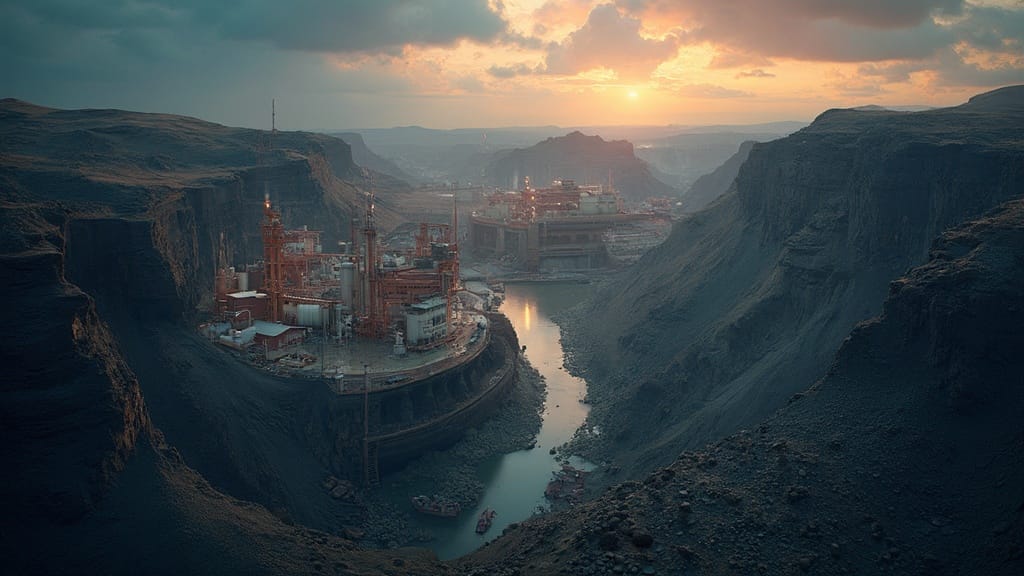
Photo: lyceumnews.com
Week of July 14, 2026
The Big Picture
This was the week the critical minerals story quietly split into two halves. In allied capitals, governments finally put structured money — not MOUs — behind processing capacity: Canada wrote its first Critical Minerals Accelerator check for germanium and antimony, and Australia named the first minerals for its strategic reserve. In Beijing, meanwhile, export controls moved from policy to prosecution — a Japanese executive detained, a domestic optics chairman under compulsory measures, and a new violation-reporting mechanism live since July 1. One side is building; the other is enforcing. Both are racing the same clock.
This Week's Stories
Canada's First Real Critical Minerals Accelerator Deal Targets Germanium, Antimony, and Gallium
If you've been skeptical that Canada's critical minerals ambitions would ever become smelters rather than press releases, this week gave you something to chew on. (Canada's First Real Critical Minerals Accelerator Deal Targets Germanium, Antimo)
On July 7, Energy and Natural Resources Minister Tim Hodgson launched the Canada Critical Minerals Accelerator (CCMA) and announced a Strategic Investment Agreement with Teck Resources Limited to expand production at Teck's Trail Operations in British Columbia — one of the world's largest integrated polymetallic smelting complexes. The expansion is part of an up-to-C$850-million potential investment by Teck that could double Trail's existing germanium and antimony capacity and add new gallium production, according to Natural Resources Canada.
Those three metals are precisely the ones China has been weaponizing through export controls since 2023: germanium (semiconductors, fiber optics), antimony (ammunition, flame retardants), and gallium (radar, solar). The structure is what makes this credible — the Canada Growth Fund would make an equity-like investment of up to C$400 million directly into the facility, and the CCMA lets Ottawa negotiate offtake rights to a portion of future output. (Canada's First Real Critical Minerals Accelerator Deal Targets Germanium, Antimo)
Processing capacity for China-controlled materials, built inside an allied country, with government offtake attached. That's structurally different from the usual announcement-without-financing pattern. The catch: it's at the agreement stage, not fully financed. Watch whether the full C$850 million reaches final investment decision, and whether allied governments — the US especially — negotiate their own offtake under the same framework. If they do, Trail becomes a shared strategic asset. If it stalls at "agreement," it joins the graveyard of critical minerals headlines. (Canada's First Real Critical Minerals Accelerator Deal Targets Germanium, Antimo)
Australia Names Its Strategic Reserve Minerals — And the List Reads Like a Counter-Move
Strategic reserves sound great in theory. The hard part is deciding which minerals go in — and Australia just answered in a way that reads like a direct reply to Beijing. (Australia Names Its Strategic Reserve Minerals — And the List Is a Direct Respon)
Australia's Export Finance and Insurance Corporation Amendment (Strategic Reserve) Bill 2026 is before Parliament, giving the government power to secure, sell and stockpile critical minerals, per the Department of Industry, Science and Resources. The first minerals in focus: antimony, gallium and rare earth elements — the exact three categories where China has imposed or threatened controls in the past two years.
The mechanism is clever: the reserve secures rights to minerals produced in Australia and on-sells those rights to meet demand — a government-backed offtake structure that de-risks projects for miners while giving allied buyers a reliable supply window, according to the Department.
The problem, as The Diplomat has noted, is that Australia still ships most of its critical minerals to China for processing before they reach end users. A reserve of unprocessed ore doesn't fix the midstream chokehold. Watch whether Australia pairs the reserve with downstream refining investment — or whether it stays a raw-material buffer that still routes through Chinese conversion. Investors have already noticed: the AFR reported ASX-listed rare earth stocks rallying on stockpile-plan optimism. (Australia Names Its Strategic Reserve Minerals — And the List Is a Direct Respon)
China's Enforcement Machine Switches On — and Catches a Japanese Executive
Everyone's been watching China's export control policy. The story that deserves more attention is China's export control enforcement — and it just got very real. (China's Rare Earth Enforcement Machine Switches On — and Catches a Japanese Exec)
Japan's government confirmed that two nationals employed by a major Japanese company were detained in Dalian in May 2026 over alleged smuggling of export-restricted goods reportedly involving rare-earth items — among the first known detentions of foreigners tied to such a violation, according to a Morgan Lewis LawFlash. Meanwhile, MOFCOM's Announcement No. 26 of 2026, effective July 1, formalized a reporting mechanism for strategic-mineral export violations — covering third-country transshipment, disguising controlled items by disassembly, and providing logistics or financial services to unlawful exports.
The reach is the point. In June, China added 10 US entities to its control list, including MP Materials and USA Rare Earth, barring anyone anywhere from providing them Chinese-origin dual-use items — a mirror image of Washington's Foreign Direct Product Rule. A Chinese optics firm disclosed its chairman was placed under compulsory measures for allegedly declaring germanium-bearing lenses as ordinary optical glass. (China's Rare Earth Enforcement Machine Switches On — and Catches a Japanese Exec)
The signal: China is now prosecuting its own exporters who route around the rules, not just foreign buyers. Any non-Chinese firm in the rare earth chain that employs Chinese nationals or touches Chinese-origin material now faces potential Chinese jurisdiction. This is a law-firm alert (Tier 2), but the MOFCOM announcement is primary and the detention is confirmed by Tokyo. Watch for whether more foreign executives are detained — that's the escalation marker. (China's Rare Earth Enforcement Machine Switches On — and Catches a Japanese Exec)
The Army Quietly Handed REalloys the Rare Earths That Actually Matter
The Army's June 25 lease announcement got coverage for its headline: military bases hosting processing plants, some $2 billion in private investment. What got missed is the specific mineral assignment.
Ioneer received a conditional lease at Tooele Army Depot, Utah, for boron; REalloys — also at Tooele — will process dysprosium and terbium, per North American Mining. Separately, Titan Mining's subsidiary Empire State Mines received conditional selection for graphite processing at two US sites, Reuters reported.
Dysprosium and terbium are the two heavy rare earths most critical to high-performance magnets in F-35s, missile guidance, and EV motors — and precisely where Chinese controls have choked volumes to near-zero. The structure has teeth: rather than lease payments, the Army takes a share of processed output, per Vision Times. Payment-in-kind means the military has a direct stake in whether REalloys actually produces.
Conditional selections aren't contracts, and processing plants take years, as Crypto Briefing noted. The question is whether REalloys can demonstrate credible separation chemistry for dysprosium and terbium at commercial grade — that's the capability gap, not the land. Construction targets 2027, production 2028. Announced, not financed, not permitted.
Japan's 90% Lithium Recovery Is Going Viral — But the Real Signal Is the Collection Gap
This one is trending hard on Hacker News (721 points as of July 14), which makes a clear-eyed read worth it. The work comes from JX Metals Circular Solutions in Tsuruga, Fukui Prefecture.
Instead of sodium hydroxide for pH adjustment, the process substitutes recovered lithium hydroxide, turning thermal-treated "black mass" — the metal-rich powder from spent batteries — into high-purity white lithium powder, with a 40% carbon-footprint cut, per Yahoo Tech. The 90% recovery rate is a lab result; mass-production validation at Tsuruga is scheduled to begin April 2027, according to NEDO's project page.
Lithium has always been the hardest battery metal to recover economically — most commercial hydrometallurgy claws back 70–80%. A durable 90% would meaningfully shift recycling-versus-mining math.
But the buried signal matters more: only about 14% of Japan's end-of-life lithium-ion batteries currently reach official collection, with many retired EVs exported entirely, TechSpot reported. A new Japanese law taking effect this year will require manufacturers and importers to collect and recycle small portable batteries. The 90% headline is a chemistry story; the collection mandate is the supply chain story. Watch collection rates, not recovery percentages — that's the actual bottleneck.
⚡ What Most People Missed
- SuperCritical Materials licensed DOE extraction technology: On July 14 the company licensed a US Department of Energy adsorbent-manufacturing process for uranium and critical-materials extraction. Single-source and promotional — but when DOE lab tech starts flowing to private hands, Washington is nudging the market to commercialize extraction know-how before assets are built.
- Western Uranium started the licensing run for a Colorado processing plant: Western Uranium & Vanadium said July 14 it's advancing toward its radioactive materials license application for the Mustang plant at the former Piñon Ridge mill site. Application-stage, not approved — but midstream capacity is exactly where US supply-chain ambitions usually die, so licensing progress is worth clocking.
- Somalia's "mineral federalism" is a quiet offtake risk: Horn Review documents regional Somali authorities claiming direct control over subsoil resources and signing extraction deals independently of Mogadishu. For offtakers, contract risk starts to matter as much as geology — the same graphite ground could be promised to multiple parties. [Source: Horn Review — English]
- Rare-earth-free motors got serious on three fronts at once: Bengaluru's Vimag Labs secured its fifth Indian patent for a magnet-free EV motor; Niron Magnetics signed an iron-nitride magnet supply deal with Japan's Aspina; and Renault detailed its wound-rotor synchronous architecture. None displace neodymium magnets overnight, but the direction of travel reshapes rare earth demand curves past 2028.
- Albemarle exited Chinese lithium conversion but kept the offtake: The world's largest lithium producer agreed to sell its 60% stake in the Qinzhou and Meishan plants for roughly $480 million while retaining long-term supply contracts — reducing Chinese regulatory exposure while keeping Western chains dependent on Chinese conversion in the near term.
📅 What to Watch
- If allied governments negotiate their own offtake rights under Canada's CCMA framework, it means Trail becomes a shared strategic asset — and a template for pooling processing risk across allies rather than each building duplicative capacity.
- If China detains more foreign executives after the MOFCOM July 1 mechanism, it means the export regime has shifted from trade policy to a personnel-risk problem that changes how firms staff any operation touching Chinese-origin material.
- If REalloys demonstrates commercial-grade dysprosium and terbium separation, it means the US closes the single hardest gap in defense magnet supply — the one MP Materials' concentrate can't fill alone.
- If Japan's new small-battery collection law lifts the 14% collection rate, it means the recycling bottleneck moves from chemistry to logistics — and Japan's lithium recovery breakthrough finally has feedstock to work on.
- If Australia issues its first strategic-reserve procurement tenders, it means stockpiling moves from concept to contracts and starts setting price floors for antimony, gallium, and rare earths.
The Closer
A Japanese executive learning that "smuggling" now includes germanium lenses declared as ordinary glass, a British Columbia smelter about to get very interesting to defense planners, and 86% of Japan's dead EV batteries quietly sailing overseas with their lithium still inside. The great irony of the week: the West finally learned how to write a check for processing capacity in the same seven days China proved it can arrest its way to enforcement — one side building the future, the other making sure you never route around the present. Mind the black mass.
Forward this to the procurement lead who still thinks "we have an offtake agreement" and "we have supply" are the same sentence.