Groundwave Weekly — Aug 13, 2026

Photo: lyceumnews.com
Week of August 13, 2026
The Big Picture
Communications resilience is no longer about keeping every link perfect. It is about deciding what survives when capacity, spectrum or satellites are contested. Taiwan rationed mobile bandwidth, Europe expanded a sovereign constellation, and the Federal Communications Commission opened two very different paths toward direct-to-device satellite service.
This Week's Stories
Taiwan Practiced the Awkward Middle Between Online and Offline
Emergency plans often assume a network is either working or dead. Taiwan tested the more realistic middle ground: millions of phones still connected, but with barely enough bandwidth to function. (Taiwan Practiced the First Hours of a Communications Crisis)
The Associated Press reported that Taiwan’s three mobile operators throttled 4G and 5G data to 256 kilobits per second for 30 minutes across seven central cities and counties on August 10. Voice calls, text messages, emergency alerts and public-safety hotlines remained available. Streaming, video calls, cloud services and mobile payments became difficult or unusable. A northern drill covering Taipei and six other jurisdictions was scheduled for August 13. (Taiwan Practiced the First Hours of a Communications Crisis)
The exercise treated bandwidth as a rationed resource. If the model works, Taiwan can preserve basic communications during congestion, cyberattack or physical network damage instead of letting high-bandwidth applications consume what remains. If it does not, essential services will fail alongside entertainment traffic. (Taiwan Practiced the First Hours of a Communications Crisis)
The revealing evidence will come at the application level: whether emergency messages received priority, which public services remained usable and how cleanly operators restored full capacity. (Taiwan Practiced the First Hours of a Communications Crisis)
The FCC Opened an Unlicensed Path From Everyday Devices to Orbit
The Federal Communications Commission adopted a proposed rulemaking on August 6 that could let unlicensed Part 15 devices communicate directly with authorized satellites across roughly 200 megahertz of spectrum, according to Light Reading.
Part 15 covers familiar low-power technologies such as Wi-Fi and Bluetooth. Extending that regulatory framework into space could give sensors, vehicles and consumer electronics a satellite fallback without requiring each device to use a mobile carrier’s licensed frequencies.
Success would push direct-to-device satellite communications beyond premium smartphones and emergency messaging. It could also force satellite operators and terrestrial-device manufacturers to solve interference, power-control and antenna constraints within inexpensive hardware. Failure will look less dramatic: restrictive power limits, band-by-band exclusions and chipmakers declining to support the resulting rules.
The next signal is in the docket. Requests to exclude particular bands would show where the broad unlicensed concept begins colliding with existing users.
Europe Added 66 Satellites to Its Sovereignty Plan
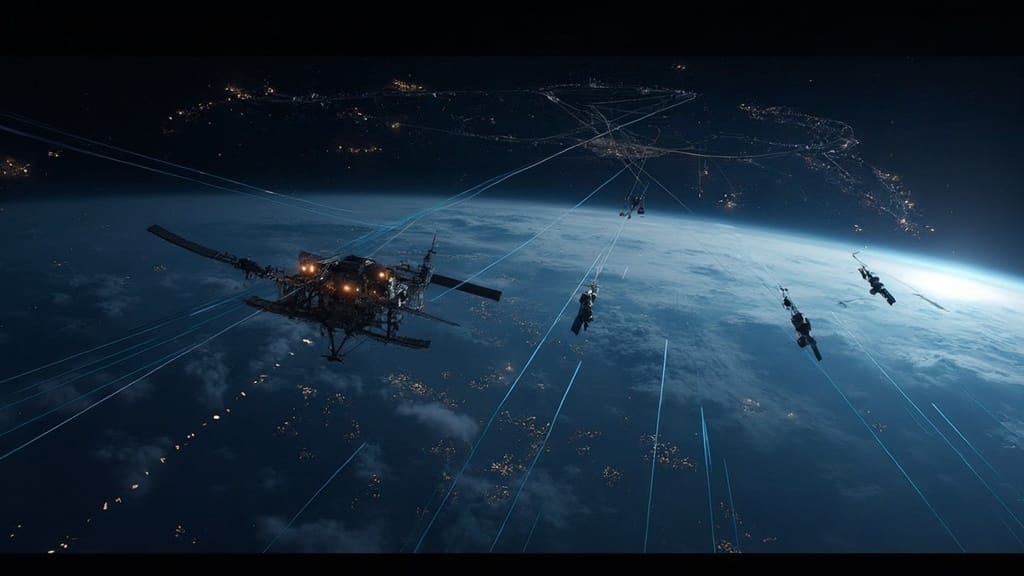
Europe’s sovereign constellation is growing before it reaches orbit. The European Commission, European Space Agency and SpaceRISE consortium moved the IRIS² secure-connectivity system into implementation with a revised architecture of 348 satellites, Tom’s Hardware reported. The redesign adds 66 spacecraft across low and medium Earth orbit, with initial launches expected from 2029.
According to figures attributed to the European Commission, the larger system is intended to provide 60% more secure government capacity inside the European Union, 54% more globally and more than five times the defense capacity during crises. (Europe’s Sovereign Satellite Network Just Got Bigger)
IRIS² is not merely a European answer to Starlink. Its intended users include European Union governments, defense organizations, emergency services and commercial customers, with 5G non-terrestrial networking and direct-to-device links also planned. If it succeeds, Europe gains control over routing, security and access during crises. If procurement slips or terminals remain expensive, Europe could own an impressive orbital network that too few users can reach.
Watch terminal manufacturing rather than satellite renderings. Affordable, interoperable ground equipment will determine whether IRIS² becomes infrastructure or symbolism.
Grain’s 800 MHz Spectrum Is Now Looking for a Satellite Partner
Grain Management now has to find a satellite partner for its nationwide 800 MHz spectrum portfolio. The Federal Communications Commission has ordered Grain Management to appoint an independent adviser and conduct a competitive search for a direct-to-device satellite partner. (Grain’s 800 MHz Satellite-Partner Search Is Now on an FCC Clock)
The order requires Grain Management to select a partner by November 5 and submit complete satellite applications by December 4. The portfolio contains approximately 13.6 megahertz of low-band spectrum formerly associated with T-Mobile and Sprint. (Grain’s 800 MHz Satellite-Partner Search Is Now on an FCC Clock)
Low frequencies generally travel farther and penetrate structures better than higher-frequency signals, making the holdings potentially valuable for broad satellite-to-phone coverage. A credible partnership could create a licensed alternative to the Federal Communications Commission’s separate unlicensed-satellite proceeding—and give a satellite operator nationwide terrestrial spectrum without acquiring a mobile carrier. (Grain’s 800 MHz Satellite-Partner Search Is Now on an FCC Clock)
Non-adoption would show up as missed deadlines, incomplete applications or proposed service that cannot meet the Federal Communications Commission’s availability and throughput conditions. The partner selection will also reveal whether 800 MHz is strategically scarce enough to attract a serious contest. (Grain’s 800 MHz Satellite-Partner Search Is Now on an FCC Clock)
The Space Force Is Building an Aggressor Range in Orbit
The U.S. Space Force wants an orbital equivalent of an aggressor squadron. Firefly Aerospace has joined the U.S. Space Force’s NITE-STAR contract vehicle, which supports realistic space training across physical ranges, simulations and potentially on-orbit systems, according to Tech Times. The six-year vehicle has a ceiling of $981 million through 2032; that ceiling is not a $981 million award to Firefly Aerospace.
Training can include communications interference, manipulated navigation signals, cyberattacks and spacecraft maneuvering into threatening positions.
If NITE-STAR produces live orbital threat-replication services, U.S. Space Force exercises can test operators and networks against adversarial behavior that simulations struggle to reproduce. If it remains mostly a contract pool and a collection of scripted exercises, the operational shift will be much smaller.
The first task orders are the test. Funding for maneuvering aggressor spacecraft would mark a consequential step; contracts limited to modeling and classroom simulation would not.
The Marines Are Forcing CJADC2 Down to the Radio Layer
The U.S. Marine Corps is pushing Combined Joint All-Domain Command and Control all the way to the radio layer. It has established Project Dynamis as its contribution to Combined Joint All-Domain Command and Control, the U.S. Department of Defense effort to move targeting and operational data among forces on land, at sea, in the air and in space. (The Marines Are Turning CJADC2 Into an Actual Network)
Project Dynamis calls for decentralized mesh networks, tactical edge computers, a common data fabric and links for autonomous systems. The architecture matters because “connect every sensor to every shooter” fails when services use incompatible formats, security rules and radios. (The Marines Are Turning CJADC2 Into an Actual Network)
An August article in the U.S. Naval Institute’s Proceedings reported that a man-portable Nokia Banshee radio created a local 250-megabit-per-second network for as many as 250 devices during an experiment. The article contrasted that performance with an existing tactical satellite architecture operating at roughly six kilobits per second. (The Marines Are Turning CJADC2 Into an Actual Network)
If Project Dynamis succeeds, the U.S. Marine Corps gains repeatable field configurations that can move useful data without perfect infrastructure. Failure will look like impressive demonstrations that cannot interoperate outside carefully prepared exercises. Common software releases and coalition field tests—not another acronym—will tell the difference. (The Marines Are Turning CJADC2 Into an Actual Network)
The FCC’s Experimental Radio Queue Is Filling With Defense Tests
Defense companies are crowding into the Federal Communications Commission’s experimental radio queue. The Federal Communications Commission’s Experimental Licensing System recorded fresh applications on August 11 and 12 from Dedrone Holdings, Raytheon, General Dynamics Mission Systems and Boeing. The system also showed an authorization for Vast granted on August 10. (The FCC Quietly Opened a 200 MHz Unlicensed Lane for Direct‑to‑Device Satellites)
The filings confirm that those companies are seeking or receiving permission for new radio-frequency experiments. The public listing does not, by itself, establish the mission, waveform or eventual product behind every application, so the cluster is a directional signal rather than proof of one coordinated program. (The FCC Quietly Opened a 200 MHz Unlicensed Lane for Direct‑to‑Device Satellites)
Still, experimental licenses are where communications links, radar techniques, interference profiles and autonomous-system radios are tested before procurement. If the filings mature into detailed authorizations and contract awards, they could reveal where counter-drone and tactical-network development is accelerating. (The FCC Quietly Opened a 200 MHz Unlicensed Lane for Direct‑to‑Device Satellites)
The alternative is routine administrative clustering with no shared technical significance. Frequency ranges, test locations and later procurement notices will show whether this is a genuine surge or merely a busy week at the licensing desk. (The FCC Quietly Opened a 200 MHz Unlicensed Lane for Direct‑to‑Device Satellites)
AT&T Can Retire Ten More Pockets of Copper
AT&T can now retire ten more pockets of copper. The Federal Communications Commission has authorized AT&T affiliates to discontinue traditional telephone service and associated wireline voice-over-IP products in ten wire centers across Louisiana, Missouri, Oklahoma, South Carolina, Texas and Wisconsin. The authorization permits discontinuance on or after August 11; it does not establish that every affected line has already been disconnected. (docs.fcc.gov)
Copper retirement happens exchange by exchange, not through one cinematic nationwide shutdown. The transition can reduce maintenance costs and move customers onto fiber or wireless systems, but it also removes a voice path that historically carried its own electrical power.
Success means replacement networks deliver better service without becoming more fragile during storms, blackouts or mobile congestion. Failure will appear in outage duration, battery-backup complaints and emergency-calling performance after the copper disappears.
The useful evidence is local: what AT&T installs, how long backup power lasts and whether the Federal Communications Commission receives service complaints from the named exchanges.
Researchers Modeled an Earthquake Listening Through Submarine Fiber

Could submarine fiber hear an earthquake? A newly posted preprint presents an end-to-end model of how earthquakes can perturb the polarization—the orientation of a light wave—inside submarine optical fiber. The researchers say the model aligns with earlier measurements, but the paper has not yet been peer-reviewed and does not describe a new operational warning network.
The attraction is enormous. Submarine cables already span ocean floors where dedicated seismic sensors are sparse. If operators can extract useful earthquake signals without disrupting communications traffic, existing fiber could become a distributed scientific instrument as well as the backbone of the internet.
The difficult part is separating geological signals from temperature changes, cable motion, optical noise and ordinary network operations. Failure would look like detections that work only after an earthquake is already known or require equipment too expensive for broad deployment.
Independent replication on live cable systems is the next threshold. Until then, this is a promising model—not an undersea seismometer hiding in every fiber pair.
⚡ What Most People Missed
- DARPA’s “Convergence” notice: DARPA says it expects to release a Convergence Broad Agency Announcement in August. The notice confirms the program’s direction, but its technical scope remains unknown until DARPA publishes the full solicitation.
- The Space Force’s low-band satellite question: An August 10 response deadline has passed for information about persistent medium-Earth-orbit service in the 244–380 MHz band, including Mobile User Objective System compatibility. No selection is established by the available material, but the request shows interest in alternatives for narrowband military satellite communications.
- Syria’s proposed Cyprus cable: Community discussion highlighted plans for the 240-kilometer UGARIT 2 cable between Tartous and Pentaskhinos, with Nokia expected to supply optical equipment. Because the available source is a Reddit thread and the project remains an agreement rather than delivered infrastructure, treat it as a project to verify—not a cable already entering service.
- When GPS goes dark: The War on the Rocks essay was published on February 19, not during this issue’s window. Its enduring point fits Taiwan’s drill and NITE-STAR: resilience comes from systems that degrade gracefully, not from waiting for one magical replacement for GPS.
- Information control through institutional access: The Guardian’s report on Federal Communications Commission Chair Brendan Carr’s Iran-war broadcast-license threat dates to March, while the dispute over the U.S. Department of Defense press policy began in 2025. Neither is fresh network news, but both show how communications authority can shape who may speak and who may observe.
📅 What to Watch
- If band-specific exclusion requests flood the Federal Communications Commission’s unlicensed-satellite docket, it means one broad direct-to-device proposal will fracture into several narrowly constrained services.
- If Grain Management attracts competing satellite applications before November 5, it means nationwide low-band spectrum has become a shortcut into the direct-to-device market.
- If NITE-STAR’s first task orders pay for maneuvering spacecraft rather than simulations, it means orbital proximity operations are becoming a routine training condition.
- If Taiwan releases emergency-priority and application-performance data, it means deliberate throttling could become an engineering standard for civilian network resilience.
- If European terminal makers submit production-ready designs before the IRIS² grant deadline on August 26, it means Europe may avoid building a sovereign constellation with foreign or unaffordable access hardware.
- If earthquake-polarization results are reproduced on operational submarine cables, cable owners may inherit a scientific mission—and a new fight over access to network telemetry.
The Closer
Taiwan put video calls on a wartime diet. The Space Force ordered an orbital villain for rehearsal, and researchers asked an undersea fiber whether it felt the earthquake.
Meanwhile, the copper phone line is leaving town just as everyone remembers electricity can also leave town.
Keep the radios charged.
Forward this to the person who still thinks “the network” is one thing.
From the Lyceum
Ukraine’s deeper strikes into Russia are turning oil infrastructure into a contest over targeting, communications and scarce air defenses. Read → Ukraine’s Drones Brought the Oil War Deeper Into Russia
TSMC’s July revenue shows no AI spending pause—and the resulting hardware still needs power, fiber and interconnects. Read → TSMC’s July Revenue Leaves No Sign of an AI Digestion Pause